
Grading beams that level a wide strip in one pass: the GRB for excavators and the GRB light for mini excavators.
The whole range: Excavator tools
Families
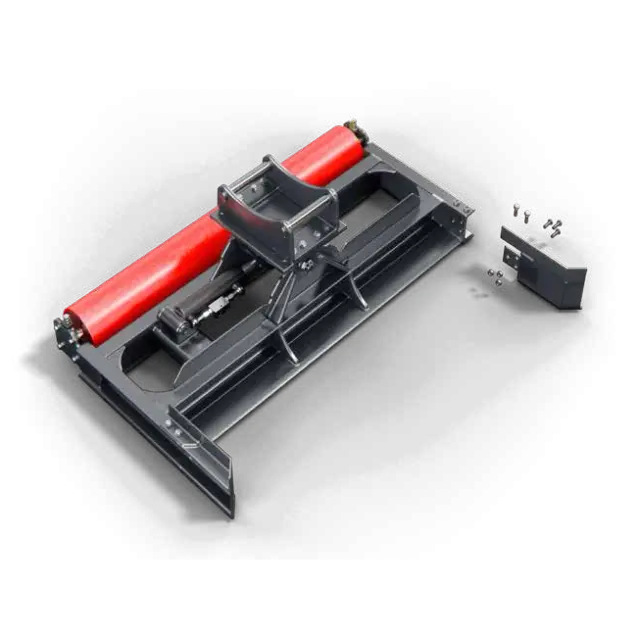
GRB Excavator grading beam
A grading beam for excavators up to 30 t. It levels large areas for driveways, roads and building sites.
- We usually reply within 1 working day
- We check the fit before we send the quote
- Every offer names the dispatch week
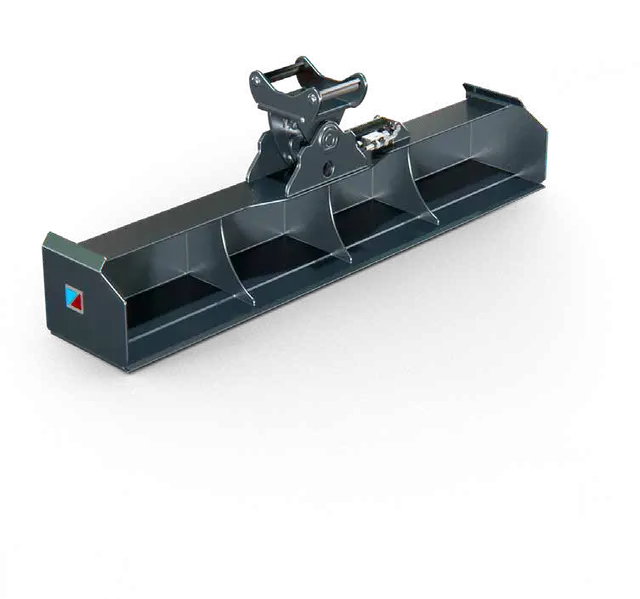
GRB light - mini-excavator grading beam with lowered mass
A grading beam for mini excavators from 0.6 to 7.0 t. It levels the ground for driveways, roads and building pads.


How to choose
A grading beam hangs on the excavator and levels a wide strip in one pass. The long blade moves the material sideways and the roller behind it rides on the ground, so the surface it leaves is flatter than the one a grading bucket leaves, and it stays flat across the whole width. Two families cover the machine range. The GRB is the excavator beam: a Basic version that is rigid and runs without a roller, a Standard version that carries a roller on bearings, and a hydraulic version that tilts up to 45 degrees to each side. It is built as GRB mini for 2.5 to 10 t carriers in 1000 and 1500 mm, as GRB midi for 6 to 18 t carriers in 2000 and 2500 mm, and as GRB maxi for 10 to 30 t carriers in 2500 and 3000 mm. The GRB light is the beam for mini excavators from 0.6 to 7.0 t, 1500 to 2000 mm wide, 86 to 141 kg depending on version and width. Both mount on a bolt-on bracket or an adapter.
- 1
Start with the carrier weight
The beam has to match the machine that lifts it. From 0.6 to 7 t the GRB light keeps the load inside the reach of a mini excavator. From 2.5 to 10 t take the GRB mini, from 6 to 18 t the GRB midi, from 10 to 30 t the GRB maxi.
- 2
Decide whether you want the roller
The Basic beam is rigid and simply drags the blade. The Standard beam carries an adjustable roller on bearings, which holds the height for you and leaves a more even finish on soft ground. On rough backfill you can do without the roller and its cost.
- 3
Decide whether you need hydraulic tilt
The hydraulic version tilts up to 45 degrees to each side, so a slope, a verge or a ditch profile is made from one machine position. Without tilt you reposition the excavator instead, which is slower but cheaper to buy and to maintain.
- 4
Then pick the width
A wider beam finishes faster and a narrower beam gets into the space you actually have. The GRB light runs 1500, 1800 and 2000 mm; the GRB is offered from 2000 to 3000 mm, and 250 mm extendable side beams are an option on it.
Questions we are asked
- Is a grading beam better than a grading bucket?
For the final surface, yes. The blade and the roller both ride on the ground over the full width, so the beam holds a flatter plane than a bucket edge that follows the boom. A bucket still wins where you also have to carry material away.
- What wears first, and can it be replaced?
The bottom edge. The cutting edge and the wear bars along the bottom are HB500, Hardox® wear bars are an option, and the bearing to roller connection is protected against knocks.
- Can I mount a laser or a level device on it?
The GRB has a mounting spot for a level measuring device as an option, so machine control or a simple level gauge can sit on the beam rather than on the stick.
- Is a leveling beam the same thing, and is there one for a wheel loader?
Yes, grading beam, leveling beam and levelling beam are names for the same tool. The GRB and the GRB light are built for excavators. On a wheel loader, the FLB levelling bucket does the finishing work: it is wide and low, spreads material in an even layer and fits loaders from 2 to 20 t.
Who builds these
- Designed and built in Ostrołęka, Poland, in our own factory.